Note: Safety technologies are not a substitute for safe driving; their effectiveness is limited, and in some situations they may not function as expected. Please refer to the Major Specifications for details of availability.
|
Dual Sensor Brake Support II (DSBS II) |
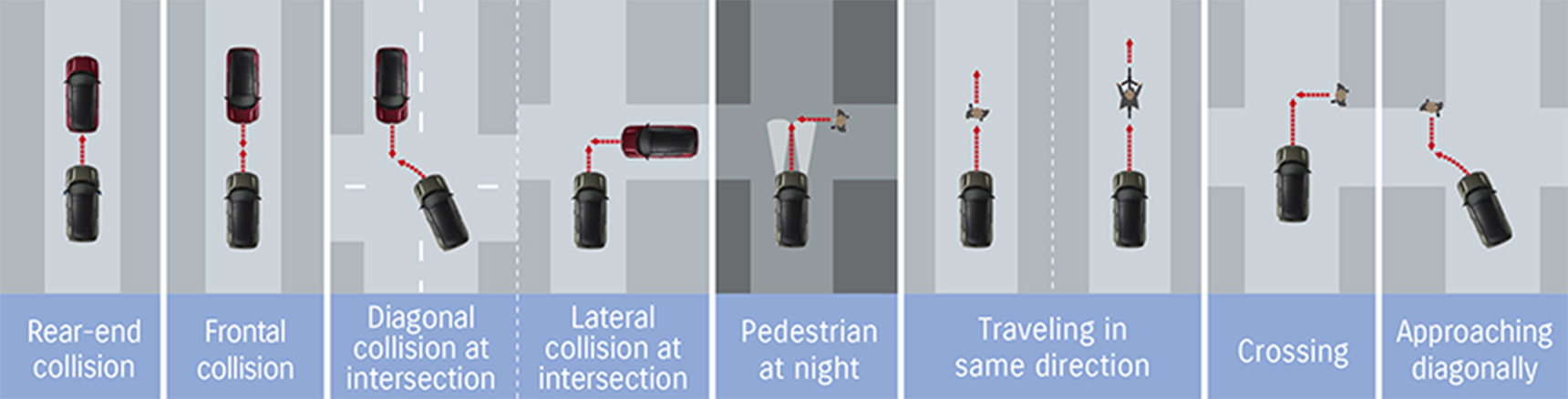
The system employs millimetre-wave radar sensors and a monocular camera to detect vehicles, motorcycles, bicycles* and pedestrian ahead of the e VITARA. Audio and visual warnings are issued to alert you if the possibility of a collision arises. If you respond with insufficient brake force, brake assist automatically engages to help slow the vehicle. And if the probability of a collision increases, brake force is applied automatically to help reduce impact force and mitigate damage.
*Daytime only
|
|
|
Lane Departure Prevention (LDP) |
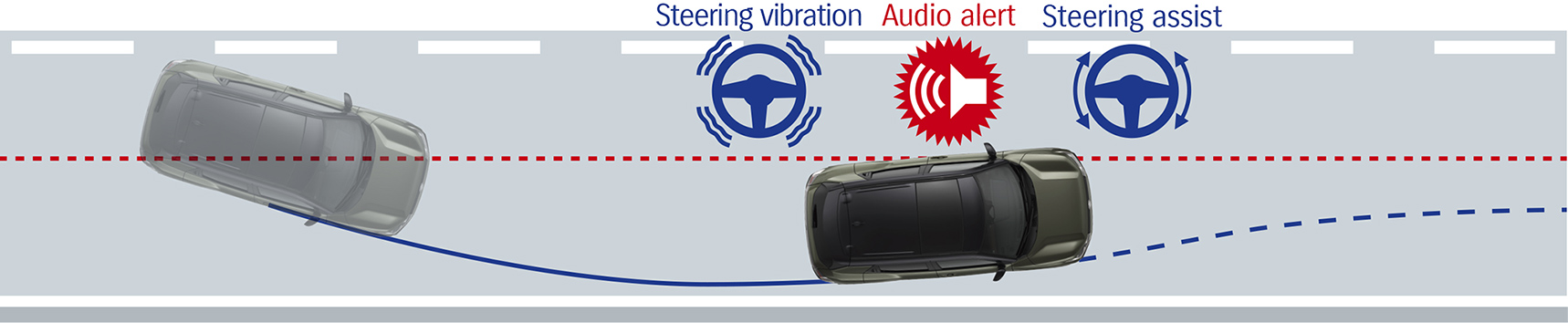
LDP detects the lane demarcation lines and predicts your path of travel as you drive. If you begin to drift due to inattention, the system alerts you by vibrating the steering wheel or sounding an audio alert. And if you fail to respond and correct, it provides steering assistance to help return your e VITARA to the centre of the lane.
|
|
|
Adaptive Cruise Control (ACC) |
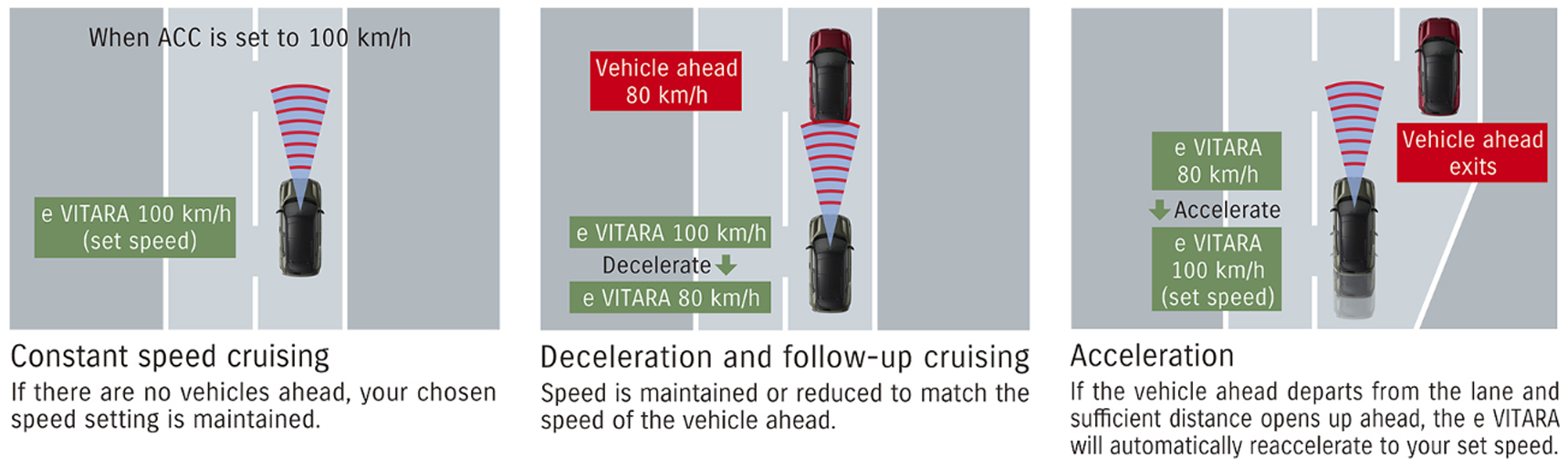
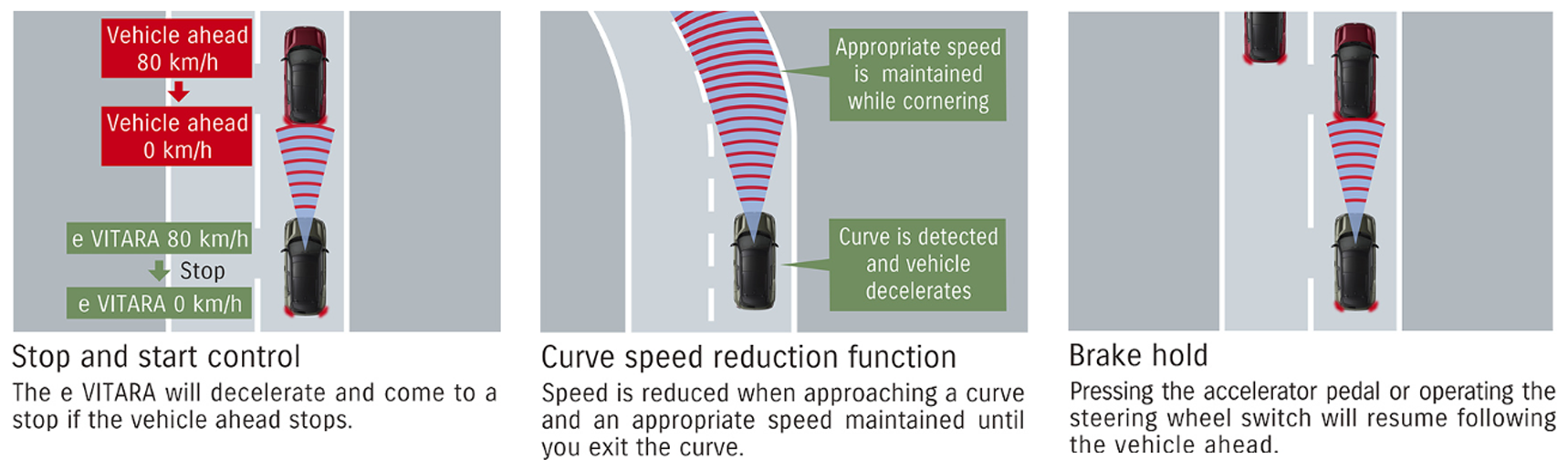
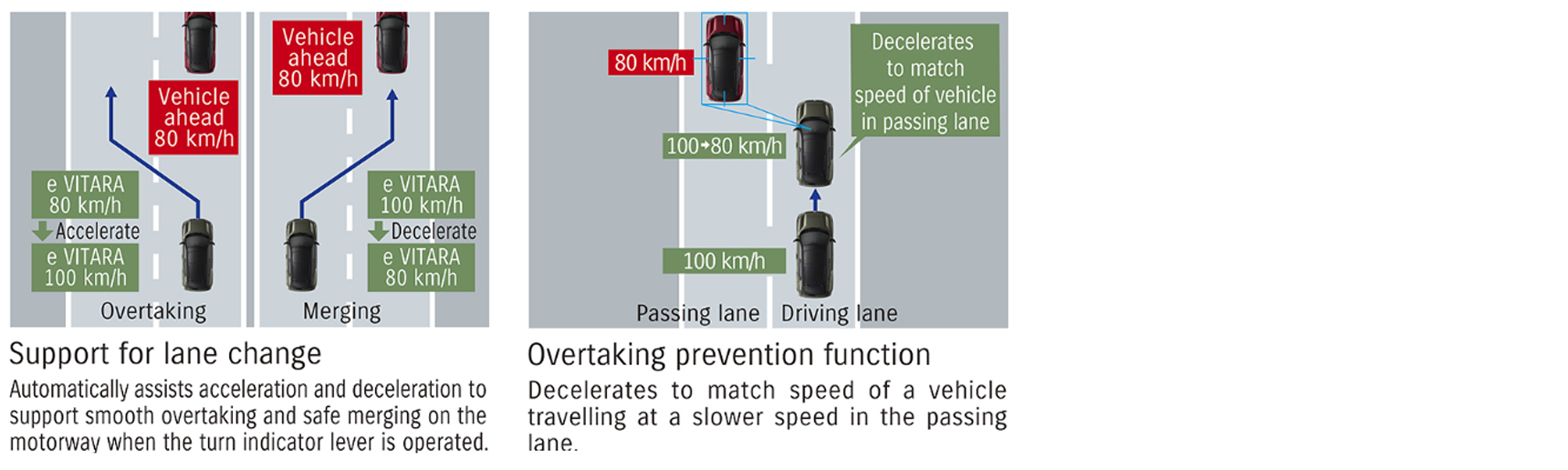
ACC helps reduce driver fatigue on long trips and when driving in traffic. The system uses millimetre-wave radar and a monocular camera to measure the distance to the vehicle ahead, accelerating or decelerating as needed to maintain the distance you have set. (You can choose from four distance settings.) If the road ahead is clear, it will maintain the speed at which you were traveling when you engaged the system. ACC can be linked to the traffic sign recognition system through the driver customisation setting. ACC set speed will be adjusted based on the posted speed limit.
|
|
|
|
|
Adaptive High Beam System (AHS) |
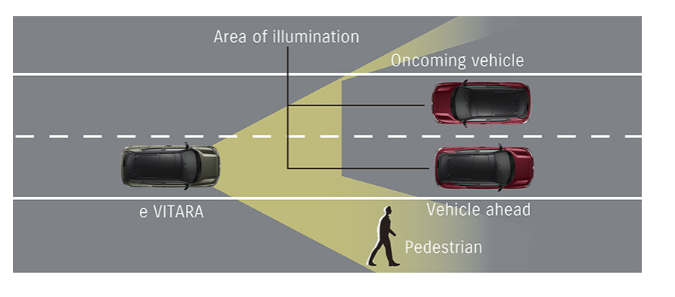 AHS uses millimetre-wave radar and the monocular camera to detect the brightness of the surrounding area and the lights of other vehicles, and adjusts the brightness and illumination range of the headlamps as needed. It also adjusts high beam brightness and illumination angle according to vehicle speed, and switches to low beam in well-lit areas. AHS uses millimetre-wave radar and the monocular camera to detect the brightness of the surrounding area and the lights of other vehicles, and adjusts the brightness and illumination range of the headlamps as needed. It also adjusts high beam brightness and illumination angle according to vehicle speed, and switches to low beam in well-lit areas.
GLX only
|
|
Blind Spot Monitor (BSM) |
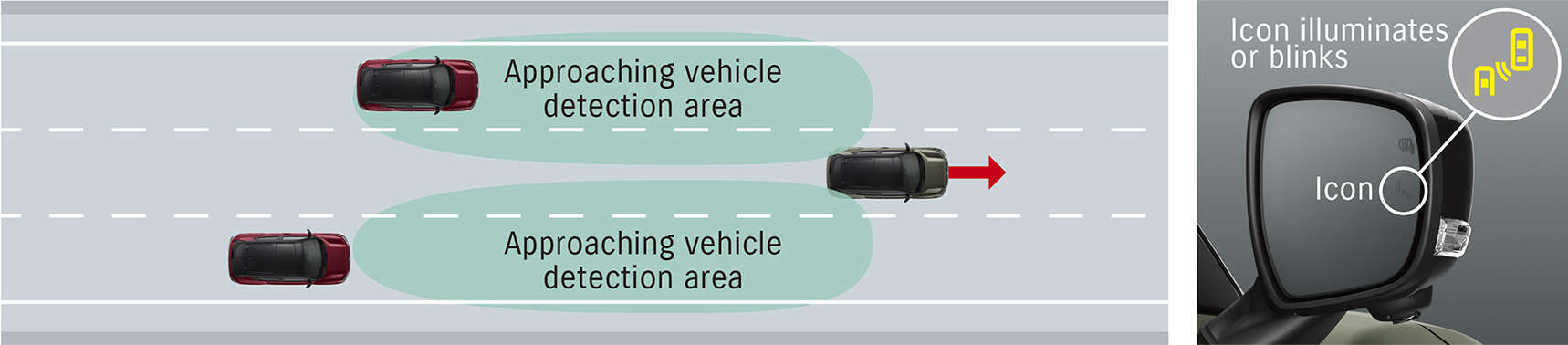
BSM uses millimetre-wave radar sensors in the rear bumper to detect vehicles located in or approaching either rear blind spot. When a vehicle is detected, a warning icon appears in the corresponding door mirror. If you activate the turn signal on that side, the icon flashes and an audio warning sounds.
|
|
|
Rear Crossing Traffic Alert (RCTA) |
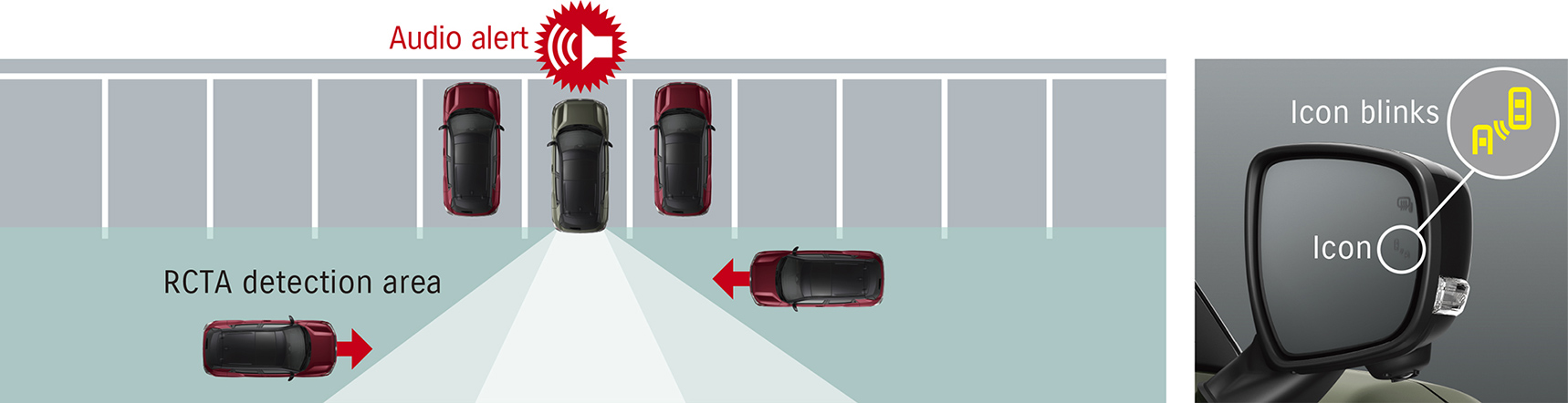
RCTA is a supplementary safety feature that uses blind spot monitor to detect and warn of vehicles approaching from the left or right when backing out of a parking space or other location.
|
|
|
Multiple collision braking |
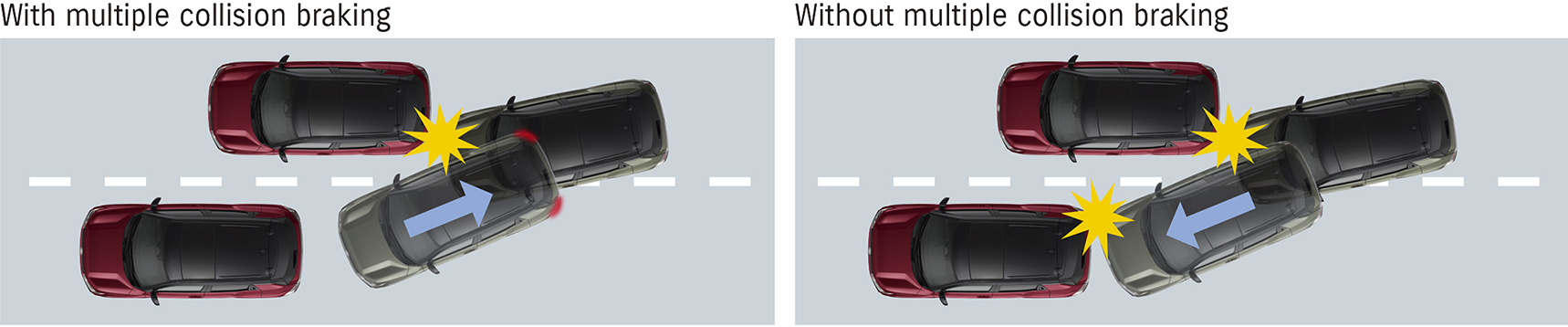
When the brake system receives a signal from the airbag that a collision has occurred, it automatically activates the brakes and brake lamps to alert nearby vehicles and help prevent a secondary collision.
|
|


